Update Odisha-Latest Odisha News I Breaking News Get latest news on Odisha, Govt. Jobs, OSSC, OPSC, Entertainment, Crime, Sports, and Education
Sabyasachi Kundu
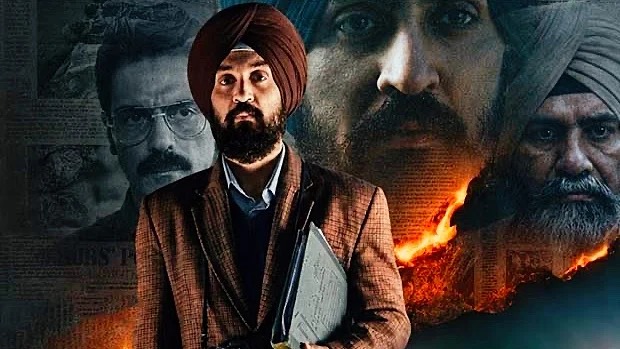
Some films entertain. Some provoke. And then there are films that force a society to confront the questions it has spent decades avoiding. Satluj belongs firmly in the last category.
The debate surrounding the film has long outgrown cinema. It has evolved into a political test that no major party in Punjab can comfortably pass. More importantly, it has exposed an uncomfortable truth: while governments have changed over the past four decades, the politics of memory and justice has largely remained the same.
The story is no longer about whether one agrees with the film’s narrative. It is about why Punjab’s political establishment still struggles to speak with clarity on one of the darkest chapters in the state’s history—the years of militancy, counter-insurgency, disappearances and allegations of human rights violations.
Perhaps the most significant political intervention has come not from any party, but from Paramjit Kaur Khalra, widow of human rights activist Jaswant Singh Khalra. Ahead of the Harike Pattan remembrance ceremony, she delivered a reminder that accountability cannot be selective.
Her criticism spared no one.
The Congress was accused of presiding over an era marked by widespread human rights violations. The Shiromani Akali Dal was questioned over why successive governments allegedly failed to pursue accountability against police officers facing serious allegations. The Aam Aadmi Party (AAP), despite promising political change, was challenged on why convictions have not translated into meaningful justice. Even the BJP-led Union government was not exempt, with references to allegations concerning targeted killings abroad.
Whether one agrees with every allegation is almost secondary. The larger political significance lies elsewhere. Her intervention dismantled the convenient narrative that only one party carries the burden of Punjab’s unresolved past.
That is precisely why the response from mainstream politics has been remarkably cautious.
Each party faces its own contradiction.
For the Congress, any renewed conversation inevitably revives uncomfortable questions about decisions taken during the counter-insurgency years. For the Akali Dal, reclaiming Panthic politics becomes difficult when critics point to its own years in power and ask why accountability remained elusive. The AAP government now confronts the reality that campaigning on change is easier than delivering justice in politically sensitive cases. The BJP, meanwhile, must balance its national security narrative with its ambitions of expanding support among Sikh voters.
No one can claim complete moral authority.
This political hesitation reflects something deeper than electoral calculation. It reveals that Punjab still lacks a shared understanding of its own recent history. Competing narratives continue to coexist—one centred on national security, another on human rights, another on Sikh identity, and another on the need to move forward without reopening old wounds.
The electoral success of independent Panthic candidates in the 2024 Lok Sabha elections should have already signalled that these questions have not faded with time.
Amritpal Singh’s victory from Khadoor Sahib demonstrated that issues of Sikh identity and perceived injustice continue to resonate with significant sections of the electorate. Sarabjeet Singh Khalsa’s election from Faridkot carried equally powerful symbolism, reminding observers that the legacy of Operation Blue Star and its aftermath still shapes political consciousness in Punjab.
Those victories challenged the assumption that Panthic politics had become electorally irrelevant.
Satluj taps directly into that unresolved sentiment.
This places mainstream parties in an impossible position. Supporting the film’s broader narrative risks alienating sections of voters who continue to prioritise the state’s security response to militancy. Rejecting or ignoring it risks appearing indifferent to demands for justice and accountability.
The result is a familiar strategy – calculated ambiguity.
Perhaps that is the film’s greatest political achievement. It has compelled every major political party to revisit questions they have collectively postponed for decades.
How should Punjab remember the years of violence? Did successive governments do enough to investigate allegations of excesses? Can justice still be pursued after four decades? Is reconciliation possible without acknowledging uncomfortable truths? And can a democratic society genuinely move forward without first confronting its past?
These are not questions that a film alone can answer.
But they are questions that politics can no longer indefinitely avoid.
Ultimately, Satluj is not reshaping Punjab’s politics because of what it says. It is reshaping the conversation because of what political parties have been unwilling to say.
The film has become more than cinema. It has become a mirror—one that reflects not only Punjab’s painful past but also the credibility of those seeking to shape its future.
Whether the political establishment chooses to look into that mirror, or once again looks away, may prove to be the more important story.