Update Odisha-Latest Odisha News I Breaking News Get latest news on Odisha, Govt. Jobs, OSSC, OPSC, Entertainment, Crime, Sports, and Education
Sabyasachi K.
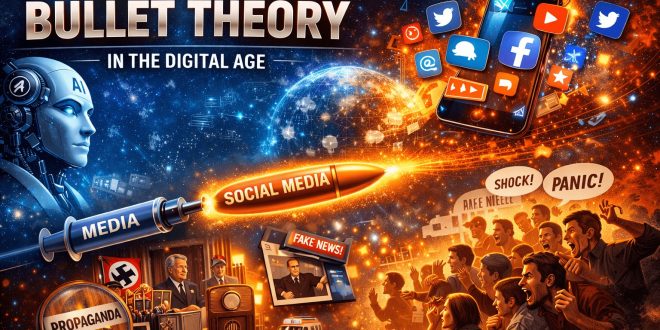
The rapid expansion of Information and Communication Technologies (ICTs), combined with the growing use of artificial intelligence and social media platforms, has transformed the way people receive, process and respond to information. This transformation has revived scholarly debate around one of the earliest theories of mass communication, the Bullet Theory, also known as the Hypodermic Needle Theory.
The Bullet Theory was propounded in the 1930s by political scientist Harold Lasswell, who argued that mass media messages have a direct, immediate and powerful impact on audiences. According to the theory, audiences were seen as passive recipients, with media messages ‘injected’ into them to produce uniform and predictable reactions. At the time, the theory appeared convincing, particularly as radio, newspapers, films and advertisements gained unprecedented reach and influence.
However, this perspective did not go unchallenged. In the 1940s, sociologist Paul Lazarsfeld, along with his colleagues, conducted influential election studies published in The People’s Choice. Their findings suggested that media influence was not direct but mediated through opinion leaders and interpersonal relationships. This work laid the foundation for the Two-Step Flow Theory, which argued that audiences actively interpret media messages rather than accepting them blindly.
For many years, these findings led to the widespread dismissal of the Bullet Theory as outdated and overly simplistic. Yet, developments in the digital era, particularly the rise of social media and AI are prompting a reconsideration of its relevance.
Media scholars and communication specialists argue that this incident reflects a core assumption of the Bullet Theory: under certain circumstances, media messages can still have direct and powerful effects on audiences. The emotional nature of the content, combined with the speed and reach of social media, appeared to override critical thinking, resulting in swift and uniform reactions.
Historically, similar effects were observed during the mid-20th century. During World War II, mass media played a crucial role in shaping public opinion. In Germany, propaganda films and broadcasts were used extensively under Adolf Hitler to unify and mobilize the population. In the United States, radio and film were equally influential. President Franklin D. Roosevelt’s ‘fireside chats’ helped reassure citizens and build public support for New Deal policies during the Great Depression. To many observers at the time, audiences appeared largely powerless to resist media influence.
Despite these, Magic Bullet Theory cannot fully explain media effects in today’s complex communication environment. Audiences now actively choose platforms, curate content, and engage in dialogue rather than simply consuming messages. Nevertheless, the digital age has introduced new dynamics. Algorithm-driven feeds, viral misinformation and emotionally charged content can still trigger immediate reactions, suggesting that elements of the Hypodermic Needle Theory may persist in specific contexts.
The conclusion is that while the magic Bullet Theory is no longer predominant, it should not be completely dismissed. Social media has expanded human interaction, encouraged user-generated content and intensified social presence-all of which can amplify media influence depending on the issue involved.
(The author is a senior communication consultant and former journalist. Views are personal.)