Update Odisha-Latest Odisha News I Breaking News Get latest news on Odisha, Govt. Jobs, OSSC, OPSC, Entertainment, Crime, Sports, and Education
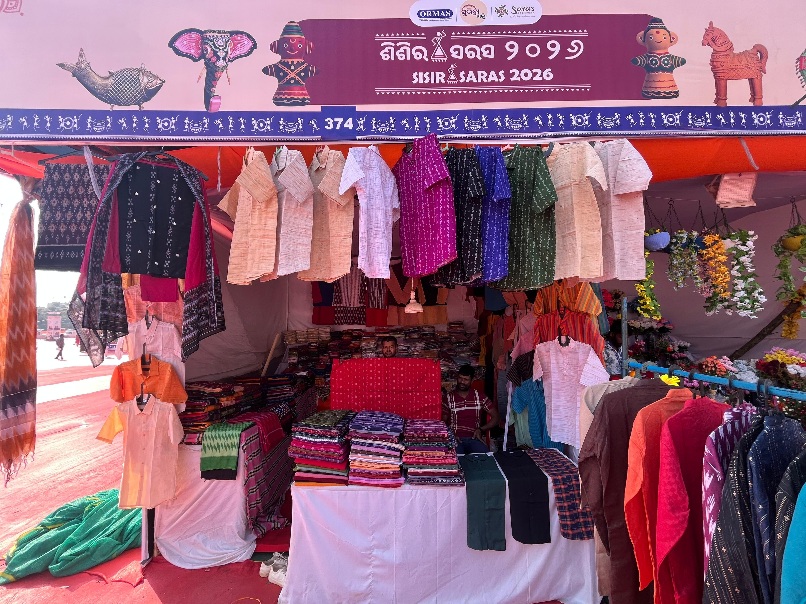
Bhubaneswar: Whether it is a wedding or a festival, everyone wishes to look attractive in beautiful attire. With changing times, people’s preferences are also evolving. Compared to heavily embroidered garments, the demand for handloom fabrics is steadily increasing. Lightweight and stylish handmade garments are now preferred by people across all age groups.
Keeping this growing demand in mind, a large number of handloom stalls have been set up at the Sisir Saras fair organized by ORMAS and Subhadra Shakti this year. Artisans from Odisha as well as more than 20 other states are participating in the fair, displaying a wide range of fabrics made from cotton, silk, tussar, khadi and wool. For customers who enjoy collecting unique fabrics from different regions, Sisir Saras has emerged as a major collection hub. A wide range of products including sarees, salwar suits, shawls for women, and handkerchiefs, dhotis and kurtas for men are available at affordable prices.
From traditional Sambalpuri sarees to handloom products from various districts of Odisha, stalls are witnessing heavy footfall. GI-tagged products such as Bargarh Ikat, Gopalpur Tussar sarees from Jajpur, Bomkai from Balangir, and Sambalpuri weaves from Sonepur and Sambalpur are attracting strong customer interest. In addition, customers are showing keen interest in purchasing kurtas, dresses, dupattas, suit pieces and fabrics. Tribal handloom varieties like Habaspuri from Kalahandi and Kotpad sarees from Koraput are witnessing particularly high demand.
Products from other states are also drawing significant attention. Punjab’s colourful Phulkari suits and sarees, Telangana’s eye-catching Banjara embroidery, Rajasthan’s block and batik prints, Andhra Pradesh’s Kalamkari embroidery, along with bedsheets, cushion covers, sofa covers and quilts are being actively purchased by visitors, often after bargaining.
Silk and Tassar collections from Banaras, Madhya Pradesh, Mysore, Bihar and Assam are appreciated for both quality and pricing. Other highlights include Goa’s crochet work such as wall hangings and table cloths, Kashmir’s Ari work, and Assam’s Mekhla Chadar. Besides textiles, handloom-made handbags, purses, jewellery, hand-painted dupattas and sarees, and a variety of home décor items are also gaining popularity.
The fair witnessed massive crowds and strong sales on Sunday, and similar trends continued on the third day as well. By the end of the third day, the total business turnover had crossed ₹3.5 crore.
Along with shopping, cultural programmes on the fourth day entertained the audience with performances such as Dhruvatara Odissi dance, Ghoda Nach, Bharatanatyam from Tamil Nadu, and a vibrant Sambalpuri Night music show by Archana Padhi, which received enthusiastic response from the spectators.
On the occasion of Makar Sankranti, ORMAS will organize a Kite Festival at the Sisir Saras fair on 14 and 15 January. It is expected that even larger crowds as visitors will be able to enjoy both the fair and the special kite festival.